
20 April 2026


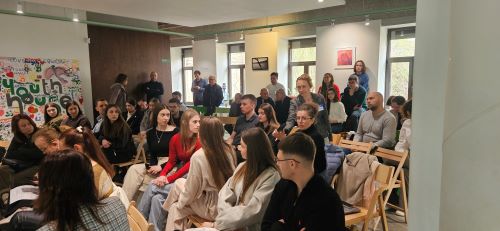
Participants of the "Youth Science and Innovation Day," held at the Ukrainian-Danish Youth House, had the opportunity to join scientific developments, test themselves in real-world projects, find teams for startups, and receive mentorship and business feedback.
The event was organized by the Innovation Center of Kyiv Academic University (KAU), the Council of Young Scientists of the NAS of Ukraine, and the Noosphere Engineering School.
Oleksandr Kordyuk, Director of Kyiv Academic University, welcomed the guests. In his report, he emphasized the existence of the so-called "valley of death"—the gap between scientific research and business implementation that significantly hinders the commercialization of findings. He stressed that overcoming this problem requires active communication and systemic interaction between scientists and businesses. Events like this play a vital role in establishing contacts, exchanging ideas, and forming multidisciplinary teams.
Oleksandra Antoniuk, Deputy Director of KAU and head of the Academ.City science park project, noted her delight in seeing schoolchildren, students, young and senior scientists, and entrepreneurs in the hall. "Scientists, businesspeople, lawyers, and economists often work in their professional 'bubbles.' It is crucial to discuss new ideas, debate, and dream together," the scientist emphasized.
Oleksandr Kovalchuk, Chairman of the Council of Young Scientists of the NAS of Ukraine, also spoke about the need for cross-sector communication platforms: "Dialogue allows us to understand what is happening in other fields and find intersection points between fundamental and applied science."
Researchers presented practical solutions for critical infrastructure recovery, healthcare, flood risk forecasting, space measurements, and more. During the discussion, business representatives and legal experts asked practical questions regarding competitive advantages, missing competencies for commercialization, and specific assistance needed.
Damage to Ukrainian infrastructure is estimated at $195 billion. Large-diameter pipes were previously produced in now-occupied territories. Yevhen Kurov (Priazovskyi State Technical University) proposed a field repair technology for damaged pipes as an alternative to purchasing new ones. His project focuses on managing thermal welding cycles so that seams can withstand shockwaves.
Young researchers Roman Kohutanych and Elina Tolochyna presented a prototype of the INFERNO mobile system. It is designed to neutralize drones using High-Power Microwave technology, regardless of their connection type (radio, fiber optic, or autopilot).
Alona Maziy, a prize-winner of the Junior Academy of Sciences (JAS) competition, presented a bioadhesive film based on hydroxyethylcellulose and propolis. It "sticks" to the mucous membrane for up to 50 minutes—long enough for active substances to neutralize pathogens and destroy microbial biofilms, a major cause of chronic infections.
Oleksandr Potapenko (NAS of Ukraine) proposed a new logic for recycling lithium-ion batteries: not just disposing of waste, but producing a material superior to the original. His project involves LFP-type cathode materials. By replacing iron with manganese during recycling, the energy characteristics of the material increase by 10–20%.
Vira Filatova (Kurdyumov Institute of Metal Physics) shared the success of the Smart Materials project, which ranked in the top five at the ActInSpace 2026 international hackathon. The team developed smart antennas for nanosatellites using high-entropy shape-memory alloys. These alloys work in a wider temperature range and ensure reliable antenna deployment in space—a critical issue that currently costs the industry $5 billion annually.
Viktor Nikoriak (Ukrainian Hydrometeorological Institute) is creating the GeoHydroAI platform to analyze water resources and flood risks. By teaching AI to identify errors in digital terrain models, he improved calculation accuracy by 50–70%. The project is supported by the German Environmental Foundation and the Bavarian Environmental Agency.
Synthesis of bioactive agents for anti-tumor and anti-viral research.
Solutions for comprehensive website CRO audits.
APISAT: Polarimetric payloads for CubeSats.
MERC-I5: A simulation complex for automated manufacturing.
CarboNova: Hybrid technology for alternative gas fuel.
VoltVision: Neural network architectures for predicting electricity generation and consumption.
Teams with the most promising projects will continue working with experts. They will undergo a course in innovation management and business modeling, receive scholarship support from the Noosphere Engineering School, assistance in creating pitch presentations and professional videos, and a project development roadmap from the KAU Innovation Center, along with a monetary award.
Prepared by Svitlana Galata