
14 March 2026


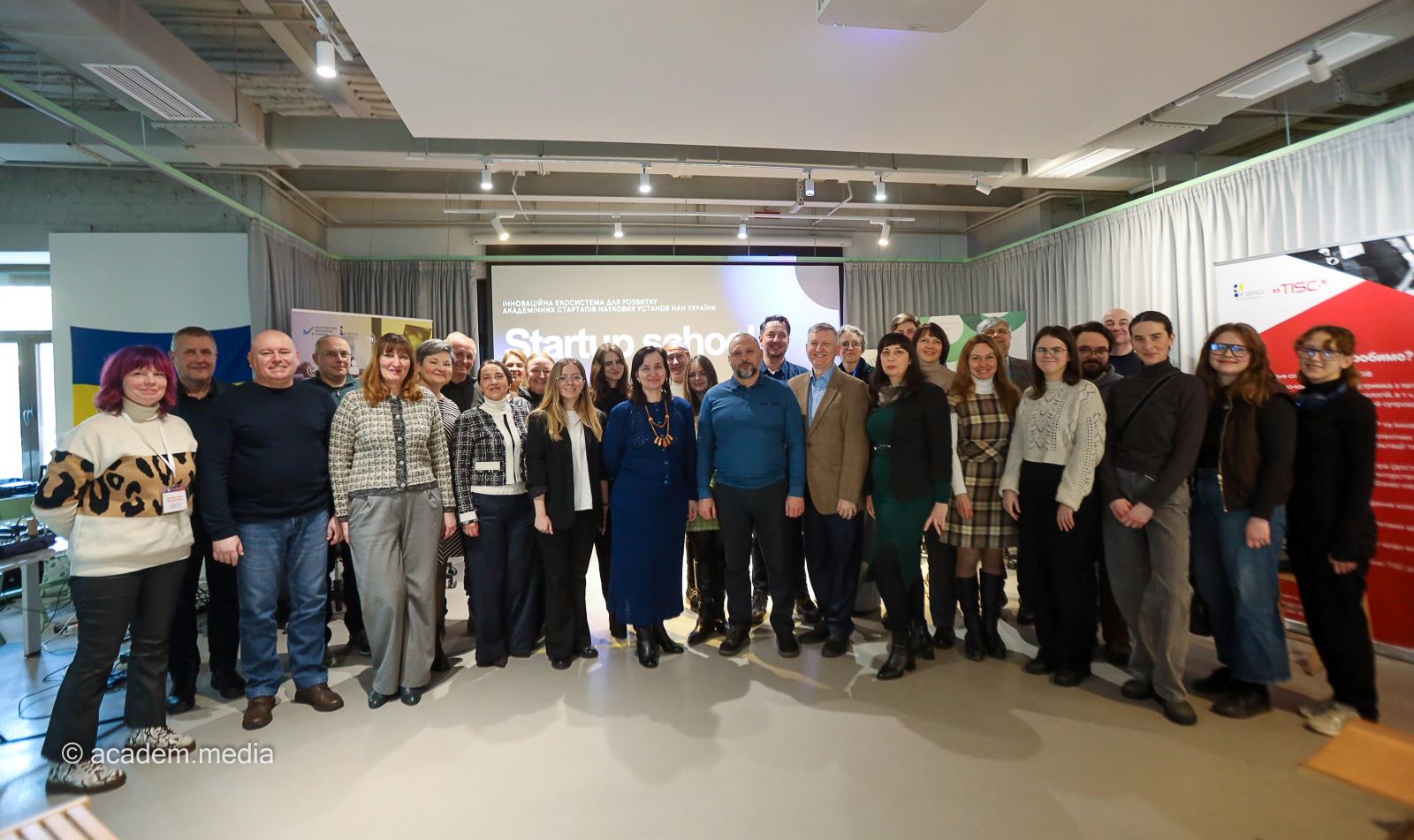
On March 4, the Innovation Center of the Kyiv Academic University (KAU) presented the results of the Academ.city startup school grant project—an innovation ecosystem designed to develop academic startups within the research institutions of the National Academy of Sciences (NAS) of Ukraine.
The meeting, held at the Ukrainian-Danish Youth House, brought together young and leading scientists, startup founders, entrepreneurs, and representatives from the Ministry of Education and Science of Ukraine, the Presidium of the NAS of Ukraine, the Ukrainian Startup Fund, the Ukrainian National Office for Intellectual Property and Innovations (UANIPIO), the Kyiv City State Administration, and the Kyiv Regional Military Administration. Many researchers also joined the meeting online. The presentations, questions, and discussions confirmed that academic startups and the commercialization of research are highly relevant topics for the scientific community. Scientists are eager to ensure that knowledge does not remain "on the shelves" but becomes a genuine force for progress.
The meeting was held with the information support of the Ministry of Education and Science of Ukraine, Ukrainian National Office for Intellectual Property and Innovations(UANIPIO), NaUKMA, Noosphere Engineering School, the Ukrainian-Danish Youth House, and Academ.Media.
All participants agreed that the cooperation between science and business is gradually transforming from a dream into a plan of ambitious tasks and initial victories.
In his welcoming remarks, Vice President of the NAS of Ukraine, Academician Oleh Rafalskyi, emphasized that the Academ.City science park initiative is a prime example for institutions with a glorious history whose future has yet to be secured by bold visions. "Youth are gathering around Academ.City and Kyiv Academic University, and this is crucial," noted Mr. Rafalskyi. "KAU trains future outstanding scientists in highly complex fields. We hope that in the near future, KAU graduates will hold key positions in European and global science."
The scientist is convinced that today offers a new impetus for cooperation between central executive authorities, research institutions, city and regional administrations, and business.
Anatoliy Bahan, Deputy Director of the Department of Industry and Entrepreneurship Development of the Kyiv City State Administration, spoke about the cooperation between the NAS of Ukraine and the city. He noted that the city funded two vital Academ.City projects: a roadmap and a financial development plan for the science park. According to Mr. Bahan, the city has already seen the benefits of implementing scientific results. "Thanks to this cooperation, measures aimed at the city's innovative development—such as an industrial hackathon and a city corporate accelerator—have appeared in the city's target program," he said. He added that while two years ago few understood what an industrial hackathon was, today both city officials and enterprise representatives recognize the value of working with scientists. Specifically, researchers have found solutions to improve the competitiveness of industrial products.
"Startup schools are the engine that will drive the city's innovative development. This year, together with the Academ.City team and KAU, we plan to hold an innovation management school for internally displaced persons," Bahan emphasized.
According to Oleksandra Antoniuk, Deputy Director of KAU and head of the Academ.City project, these early successes were made possible by the support of the NAS of Ukraine, the IP Office, financial backing from state and city authorities, and coordinated teamwork. "We started with a dream to create an ecosystem where every scientist can fulfill their potential and contribute to the state's development," Ms. Antoniuk said with a smile. "Now our project is growing; we are learning, making mistakes, and correcting them. This experience has helped us rethink many things, and much of it has already proven useful—for instance, in creating the legal mechanism for the Science.City project."
Denys Kurbatov, Deputy Minister of Education and Science, provided more details on the Science.City project and other initiatives transforming Ukraine's science and innovation sectors. He noted that many initiatives have already been implemented, with more in the pipeline. Funding for the scientific sphere in 2026 increased by 41%, including over 3 billion UAH in additional funding based on state attestation results. For the first time, 50,000 scientific and pedagogical workers will receive salary bonuses based on these results.
"This is our joint achievement: we are implementing reforms and transformations that help increase funding," emphasized Mr. Kurbatov. Among the Ministry's initiatives are the creation of six Centers of Excellence (with 1 billion UAH allocated for equipment and competitive salaries), the National System of Researchers, the launch of project-based doctoral studies (the first 100 PhD students will be enrolled this year), and the Science City ecosystem.
Young scientists asked the Deputy Minister whether there would still be a place for fundamental science. (They admitted to fearing uncertainty regarding the future of basic research.) They also asked whether institutions might redirect salary bonuses to infrastructure repairs. "No, they won't," the Deputy Minister assured. "Laboratories or departments will receive bonuses depending on their attestation results." He also emphasized that the Ministry has not stopped any fundamental or advanced research projects.
Invited speakers Serhiy Veretyuk (Head of Noosphere Engineering School) and Dmytro Kuzmenko (Executive Director of the Ukrainian Venture and Private Equity Association) discussed cases of science-business interaction and the educational challenges involved.
Serhiy Veretyuk reminded the audience that engineering is the most critical link in converting science into applied inventions. He believes scientists should not necessarily be businessmen; their role is to expand the scientific picture of the world, while engineers turn that knowledge into innovative technologies.
Dmytro Kuzmenko began his speech with a slogan that could represent any academic startup: "Dream big!" He provided recommendations on how to turn an academic startup into a European-level business.
Yuliana Zukh-Kipriianova, a leading IP professional at UANIPIO, spoke about IP strategies for startups. Olha Sokolova from the Kyiv Regional State Administration discussed the role of innovation ecosystems in regional smart specialization. Lesya Sobolevska, project manager at the Ukrainian Cluster Alliance, spoke about the experience of European Digital Innovation Hubs (EDIH), which help businesses test innovations. One such hub (Kyiv HiTech) operates based at Kyiv Polytechnic and KAU.
The greatest attention was focused on the results of the Academ.city startup school. Project head Nataliia Harashchenko noted that while the project officially started in autumn 2024, support for innovation teams began much earlier.
The success is reflected in the numbers: achieved indicators often exceed planned KPIs by tenfold. For instance, startups received nearly 16 million UAH in financial and other aid, despite an original plan of only 500,000 UAH. While the team expected 140 participants, over 1,440 people joined the activities. Mentorship and consulting were provided to 127 innovation teams.
"Scientists told us they changed their attitude toward business and innovation. Today, they view cooperation with business and participation in grant programs differently," said Ms. Harashchenko. She believes the growing number of scientists eager to see their work benefit society is more important than the statistics.
Specific program leaders shared further details:
In 2025, the department held two trainings on the preparation of grant applications, in which more than 300 scientists from over 80 institutions and organizations took part. Also, the Academ.City acceleration program was conducted, built on the basis of the European Innovation Council approach. Over the course of six weeks, 22 teams developed project concepts and submitted ten applications to a European grant competition.
Vadym Horenko, Director of "Academ.City Project Office," shared a success story involving the Institute of Cybernetics and the "Roza" knitting factory. What began as a PhD dissertation evolved into a smart production control system that uses optical sensors to detect defects in fabric that are invisible to the naked eye.
Another striking example is Viktor Kyslyuk from the Kurdyumov Institute of Metal Physics. After participating in the BOOSTER program and grant writing training, he successfully assembled an international consortium of eleven participants from different countries and submitted a Horizon Europe proposal. His project, AMELIO, focuses on diagnostic technology for solar module encapsulants.
In 2026, the school plans to expand into consulting, legal support, and marketing. A new Academ.City Open Innovation program will also launch to bridge the gap between science and business. The strategic goal remains building a sustainable ecosystem where science, business, government, and civil society interact systematically to bring scientific developments to the market.
Prepared by Svitlana HALATA
More photos on Academ.Media
The event is part of a pilot project by the Ministry of Education and Science of Ukraine to create a network of startup schools, incubators, and accelerators based at higher education and research institutions.